

FibroScan in Gilbert, AZ: A 10-Minute, Needle-Free Check on Your Liver Health
A FibroScan is a quick, painless scan that checks your liver for fat and scarring. It takes about 10 minutes, uses no needles, and you can get your results the same day. At Gilbert Center for Family Medicine, it helps us find liver problems early, often before you feel anything.
Medically reviewed by Sunildat Maheshwari, MD —
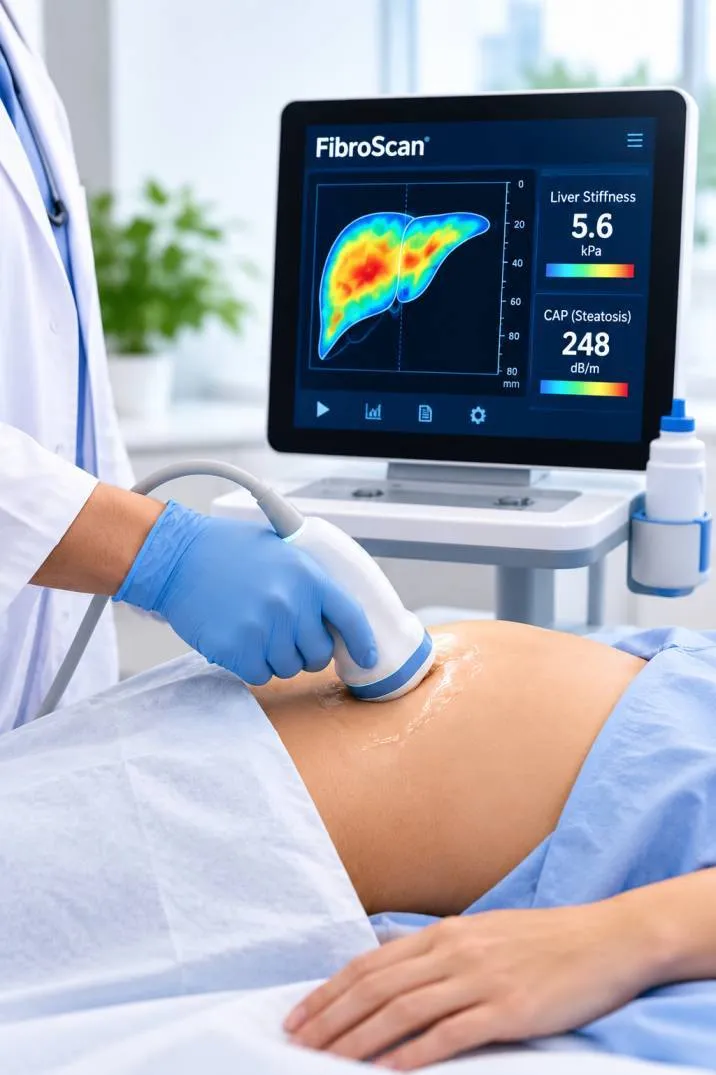
What is a FibroScan?
A FibroScan is a special kind of ultrasound for your liver. It estimates liver health by timing how fast a gentle wave moves through your liver tissue.
How it works
A healthy liver is soft, like a sponge. As scar tissue builds up, the liver gets stiffer, and a wave moves faster through stiff tissue than soft tissue. The FibroScan probe sends a small, painless pulse into the liver and measures that speed. At the same time, it measures how much the ultrasound signal weakens, which rises as fat builds up.
Why it’s used in primary care
FibroScan has become a common tool in primary care because it helps find liver disease early.
Why did my doctor order a FibroScan?
A FibroScan lets you and your doctor see what’s going on, so you can take action while your liver can still heal. Your liver does a lot of work, but it rarely tells you when something is wrong. About one in three adults has extra fat in their liver and doesn’t know it. Your doctor wants a clear picture of your liver because you have something that can put extra strain on it, like:
Diabetes or prediabetes
Extra weight, especially around your middle
High blood pressure or high cholesterol
Liver numbers that came back a little high on your blood work
A past scan that showed fat in your liver
Hepatitis B or Hepatitis C, or a medication that can affect the liver
The most common reason is fatty liver disease, now called MASLD. It affects about one in three adults and usually causes no symptoms. A FibroScan helps your doctor catch it early, when simple changes like diet, exercise and better blood sugar control can help your liver heal.
What to expect
A FibroScan exam takes about 10 minutes, and most visits are done in under 30.
Before
- Fast for 2–3 hours before the exam. Eating can raise liver stiffness and falsely affect results.
- Avoid alcohol for 24 hours before the scan. Alcohol temporarily inflames the liver and can affect the stiffness level.
- Stay hydrated. Water will not affect the results.
- Medications: take as usual with water unless you’re specifically told to skip a dose.
- Wear comfortable clothing that allows easy access to your right side and abdomen.
- Let us know if you’re pregnant or have a pacemaker.
During
You’ll lie on your back with your right arm over your head. We’ll put a little cool gel on your right side and rest a small probe between your ribs. You’ll feel a light tap, like a finger flick, a few times. That’s it.
After
There’s no downtime. You can drive, eat and go about your day. Your provider can go over your results with you right away.
What do my FibroScan results mean?
Your FibroScan results will contain two separate measurements.
Liver Stiffness Measurement (LSM)
Measures the scarring of the liver (fibrosis).
CAP score
Measures the fat stored in your liver (steatosis).
| Score | What it usually means |
|---|---|
| Under 8 | Your liver looks healthy or has very little scarring |
| 8 to 12 | There may be some scarring; we’ll keep a closer eye on it |
| Over 12 | There may be more serious scarring; we may refer you to a liver specialist |
| Score | What it usually means |
|---|---|
| Under 248 | Normal, with little or no extra fat |
| 248 to 274 | Some extra fat |
| 275 or higher | A significant amount of extra fat |
Your healthcare provider will interpret these results based on your medical history. The context of your symptoms, blood tests and personal history matters in the interpretation of your results.
Do I still need a liver biopsy?
Usually not. In the past, checking for liver scarring meant a biopsy, where a needle takes a small piece of your liver. A FibroScan gives your doctor much of the same information with no needles, no pain and no recovery time. A biopsy is now saved for the few cases where the answer isn’t clear.
Whether you need one is a decision you and your provider make together, based on your scan results, blood work and overall health. If you have questions or concerns, bring them up at your visit.
Frequently Asked Questions
No, a FibroScan is not painful. You’ll just feel a light tap on your skin. This scan is preferred by patients as there are no needles and no radiation.
Yes, fast for a minimum of 2–3 hours before your appointment. Stay hydrated, as water is fine and will not affect the results.
A FibroScan is not used to detect liver cancer. It checks for fat and scarring, not tumors. If your provider is worried about cancer, they’ll order a different scan.
Liver damage often can be reversed, especially when it’s found early. Taking care of your liver with healthy habits and treating conditions like diabetes can help your liver heal.
A FibroScan should not be completed if you’re pregnant, have a pacemaker, or have fluid built up in your belly. Make sure to bring this to the attention of your ordering provider.
Medicare, Medicaid and many private plans cover FibroScan when it’s medically necessary. Our billing team at 480-539-8680 can help you check your plan.
Schedule Your FibroScan Today
Call our office or book online. We’ll answer your questions and help you decide if a FibroScan is right for you.